

Switched-On Schoolhouse was once a popular choice for tech-savvy homeschool families who liked the idea of handing some of the teaching—and a good portion of the grading—over to the computer. Because sometimes the computer is the most patient member of the homeschool.

I hope you enjoy reading this blog post. If you want to do my course on how to homeschool, click here.
Also known as SOS, Switched-On Schoolhouse was a Christian, computer-based homeschool curriculum covering Grades 3–12.
It included lessons, quizzes, tests, and automatic grading, making it especially appealing to parents who wanted their children to work more independently.
And just to clear up one very common misunderstanding: Switched-On Schoolhouse was not an online homeschool curriculum.
It was an offline program installed directly onto your computer, although it could connect to the internet for certain features.
In this article, I’ve distilled feedback from around 25 Switched-On Schoolhouse reviews written by homeschooling parents and students who actually used the program.
We’ll look at what families loved, what drove them slightly mad, the major pros and cons, and how SOS compared with other Christian homeschool curricula.
Important 2026 Update
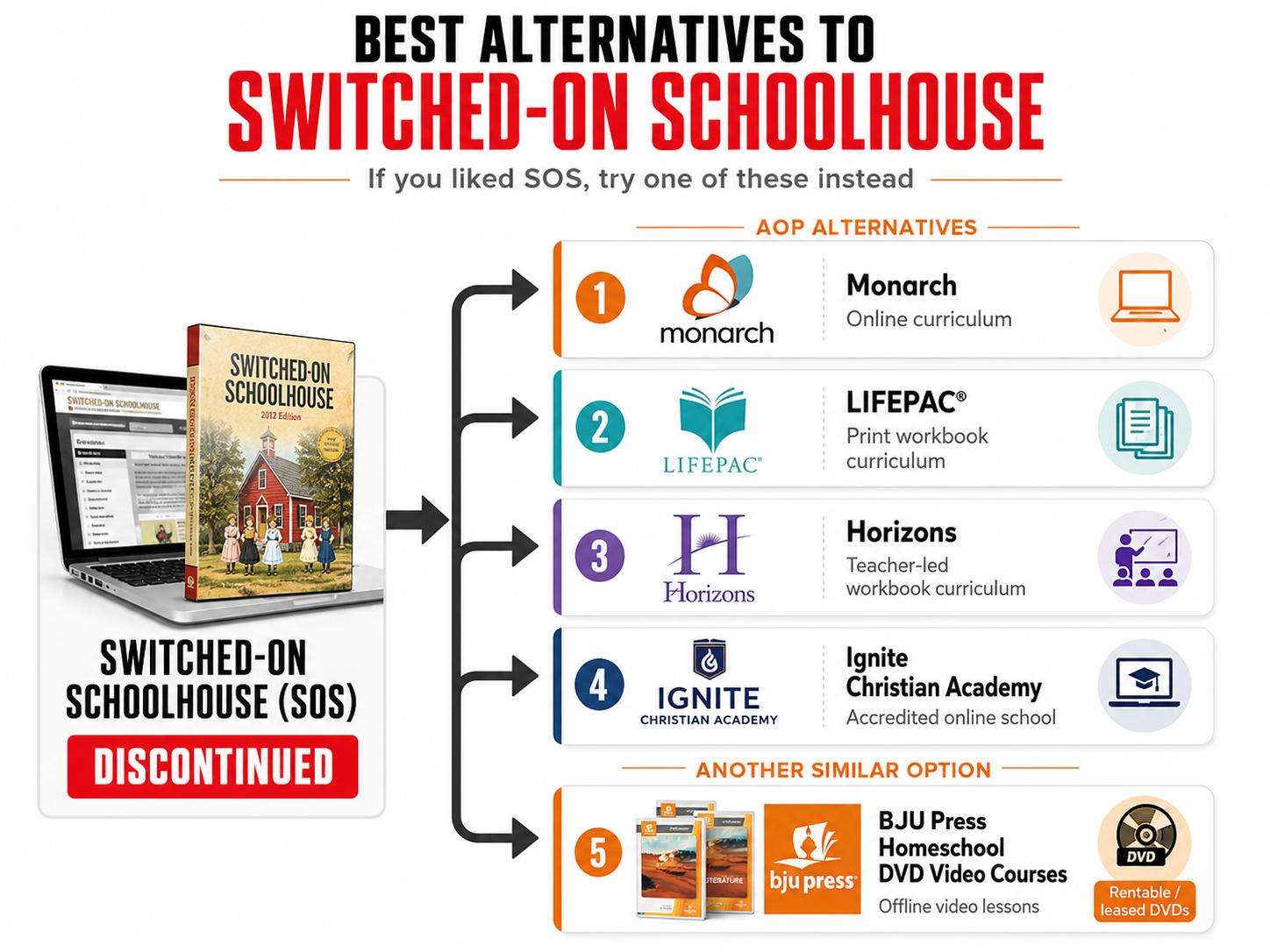
Switched-On Schoolhouse has been discontinued and is no longer sold or supported by Alpha Omega Publications.
You may still find old or second-hand copies floating around online, but buying discontinued computer software can be a little like adopting a very old printer: it may work beautifully, or it may spend three hours asking for a registration code nobody has.
For that reason, I generally wouldn’t recommend buying SOS today unless you already understand the installation, registration, and computer compatibility risks.
However, this article is still useful for families who already own the program, are researching second-hand copies, or simply want to know what happened to it.
And if you were attracted to SOS because you wanted a Christian curriculum that encouraged independent learning, BJU Press Homeschool is the alternative I would look at first.
Contents
- About Switched-On Schoolhouse
- What Homeschooling Method Did SOS Use?
- Was Switched-On Schoolhouse Accredited?
- What SOS Homeschool Reviews Say
- Monarch vs. Switched-On Schoolhouse
- What Grades Did SOS Cover?
- Were Samples Available Before Buying?
- Pros and Cons of Switched-On Schoolhouse
- How Much Did SOS Cost?
- Should You Buy Switched-On Schoolhouse Second-Hand?
- The Best Switched-On Schoolhouse Alternatives
Let’s take a look at what made SOS so popular—and why buying it now may require a minor degree in vintage computer software.

About Switched-On Schoolhouse
Who Published SOS?
Switched-On Schoolhouse was published by Alpha Omega Publications, usually shortened to AOP because homeschool companies apparently enjoy giving us one more acronym to remember.
AOP still publishes several other Christian homeschool options, including:
It also operates Ignite Christian Academy, its accredited online school.
Monarch
Monarch is AOP’s online Christian homeschool curriculum for Grades 3–12.
Like SOS, it includes multimedia lessons, automatic grading, scheduling and recordkeeping. Unlike SOS, however, Monarch operates online through a subscription.
That means there are no discs to install, no software from 2011 glaring suspiciously at your new computer and no desperate search for a registration code written on a piece of paper somebody threw away six years ago.
It also means students need reliable internet access to complete their lessons.
Monarch is probably the closest current AOP alternative to SOS, but it isn’t simply SOS moved online. It has its own platform, subscription system and updated course structure.
LIFEPAC
LIFEPAC is AOP’s self-paced Christian workbook curriculum for Grades K–12.
Each subject is divided into a series of smaller worktexts rather than one enormous textbook capable of causing immediate discouragement when it lands on the kitchen table.
Students can progress through the books at their own pace, moving quickly through easier material and slowing down when a concept needs more attention.
This can make LIFEPAC useful for independent learners and families who want the flexibility to use different grade levels for different subjects.
It may also suit some children with learning difficulties because parents can adjust the pace without a computer cheerfully announcing that the next lesson is already overdue.
LIFEPAC was the original print curriculum behind the development of Switched-On Schoolhouse. SOS took that general self-paced approach and delivered it through computer software, while Monarch later offered AOP families an online option.
Horizons
Horizons is AOP’s colourful, teacher-led workbook curriculum.
It uses a spiral learning approach, which means concepts are introduced, reviewed and reinforced regularly rather than taught once and then abandoned in the hope that everyone remembers them forever.
Horizons is best known for its early-learning courses, maths, phonics and reading, spelling, penmanship and health materials.
When AOP says Horizons is “teacher-led,” the teacher is generally the homeschooling parent.
You are still homeschooling; nobody from AOP is going to appear at your front door at 8:30 a.m. holding a whiteboard and asking why the children are still wearing pyjamas.
What Should You Use Instead of SOS?
If you liked SOS because it encouraged independent learning and kept lessons on the computer, Monarch is the most obvious AOP replacement.
However, I personally use BJU Press Homeschool with my own children, and it would be my first recommendation for families wanting strong Christian academics, engaging teachers and increasing independence.
Most families now choose BJU Press’s online video lessons through the Homeschool Hub.
But if the part you loved about SOS was keeping lessons offline, take a look at the BJU Press DVD option.
BJU’s DVD courses allow children to watch their video teachers without relying on the internet, making them one of the closest current alternatives in feel to an offline program like SOS.
They are not an exact replacement: SOS was interactive computer software with built-in grading, while BJU’s DVD courses combine recorded teachers with physical textbooks, worktexts and parent materials.
So the computer may still teach the lesson, but it will not mark every answer while you drink a peaceful cup of tea. We cannot have everything.
BJU Press DVD courses are leased rather than permanently purchased, and the discs must be returned after the access period.
What Features Did Switched-On Schoolhouse Offer?
One reason SOS became so popular was that it moved a large amount of homeschool administration onto the computer.
Its features included:
- Automatic grading: SOS graded many lessons, quizzes and tests automatically. Parents could review assignments, scores, projects and grades without wading through mysterious piles of paper that everyone insisted belonged to somebody else.
- Multimedia lessons: Students learned through written material, videos, animations, audio clips and interactive activities. This made SOS more engaging than a plain textbook for children who enjoyed working on a computer.
- Daily lesson tracking: Parents could see which lessons had been completed and whether their child had spent the morning studying science or perfecting the ancient art of staring at the login screen.
- Scheduling and recordkeeping: The program helped families organise lessons, track progress and maintain academic records.
- Adjustable assignments: Parents could preview, assign, remove or reschedule work according to the needs of the student.
- Parent-student messaging: Students could send messages to their parents from within the program when they needed help or wanted clarification.
Because SOS was installed on the family computer, most of these features worked offline.
It could connect to the internet for certain functions, but it was not an online curriculum like Monarch.
Unfortunately, because Switched-On Schoolhouse has now been discontinued, its clever features come with a very modern problem: old software does not always enjoy meeting new computers.
What Grades Did Switched-On Schoolhouse Offer?
Switched-On Schoolhouse was designed for students in Grades 3–12.
It did not include preschool, kindergarten, first grade or second grade, so families had to use another curriculum during the early years before moving their children into SOS.
That was not necessarily a bad thing.
Young children usually benefit from plenty of books, conversation, movement, manipulatives and actual pencils—even when they hold the pencil as though they are attempting to stab the worksheet into submission.
I personally prefer not to put very young children in front of a computer for large portions of the school day, although every family will need to decide what works for their children and circumstances.
For a Christian curriculum that begins much earlier, I use BJU Press Homeschool with my own children.
BJU Press offers curriculum from K3 through Grade 12, so families can begin with colourful, hands-on early-learning materials and gradually introduce more independent video lessons as their children grow. Families can choose parent-led textbooks, online video lessons or DVD courses for many grade levels.
This creates a smoother path than beginning with one curriculum for the early years and then suddenly introducing an entirely different system in Grade 3.
Of course, children generally cope with changing curriculum better than parents do.
The children say, “Oh, a new maths book.”
The parent spends three weeks comparing scope-and-sequence charts and wondering whether switching spelling programs will permanently alter the course of civilisation.
How Much Did Switched-On Schoolhouse Cost?
When SOS was still being sold, a complete grade-level set generally included:
- Mathematics
- Language arts
- Science
- History and geography
- Bible
Families could also purchase four-subject sets without Bible or buy some subjects individually.
In 2019, the complete five-subject sets were generally priced at approximately $390–$413 USD, depending on whether the curriculum came on CD or USB.
The four-subject sets without Bible were approximately $339 USD.
These prices are included only as a historical reference.
Switched-On Schoolhouse has now been discontinued, so there is no longer an official current retail price. Any copies you find today will generally be old stock or second-hand products being sold at whatever price the seller decides to place on them.
And sellers can become remarkably optimistic when they realise they possess “rare educational software.”
A high second-hand price does not mean the curriculum will install, register or operate correctly on your computer.
Before purchasing an old copy, you would need to consider:
- Whether all discs or USB components are included
- Whether the registration information is still available
- Whether the program has already reached its permitted installation limit
- Whether it will run on your operating system
- Whether the seller can provide any meaningful technical help
- Whether you are comfortable purchasing unsupported software
SOS once allowed families to install the program on several computers and use the curriculum with multiple children in the household.
That made it reasonably economical for larger families when it was actively sold and supported.
But those old licensing benefits are much less valuable if your modern computer looks at the installation disc and responds with the digital equivalent of, “Absolutely not.”
For that reason, I would not recommend paying hundreds of dollars for a second-hand SOS set today.
Can You Still Buy Individual SOS Grades?
You may still see individual Grade 3–12 sets listed on Amazon, eBay, homeschool marketplaces or second-hand curriculum groups.
However, these are not newly supported editions from Alpha Omega Publications.
I have removed the old grade-by-grade shopping list from this article because sending readers toward discontinued software without knowing whether it can be registered would not be particularly helpful.
It would be a little like recommending a lovely holiday house and casually forgetting to mention that nobody knows where the key is.
Families wanting something similar should instead consider a currently supported curriculum.
Monarch is AOP’s closest active online alternative, while LIFEPAC retains AOP’s self-paced workbook approach. AOP currently presents Monarch, LIFEPAC and Horizons among its active Christian homeschool options.
For families who want recorded Christian teachers, structured lessons and the ability to work without constant internet access, I would look at the BJU Press DVD courses.
BJU is not identical to SOS because students complete much of their work in physical books rather than inside interactive computer software.
However, the DVD option preserves one of SOS’s greatest attractions: your child can receive instruction from a recorded teacher without needing to stream every lesson online.
How Did Families Choose the Correct SOS Grade?
Alpha Omega Publications previously offered a Switched-On Schoolhouse Diagnostic Student Placement Test covering Grades 3–12.
Families could use it to assess each child and decide which grade level or individual subjects were most appropriate.
This was useful because children are not always working at the same grade level across every subject.
A student might need Grade 5 language arts, Grade 6 science and Grade 4 maths—which is one of homeschooling’s great advantages and one of online checkout’s great complications.
However, because SOS has been discontinued, I would not use an old placement test as the first step toward purchasing the program today.
The much larger questions are whether the software will install, whether it can still be registered and whether it will work reliably on your computer.
AOP still provides placement guidance and diagnostic assessments for active curricula such as LIFEPAC, which allows families to choose different levels for different subjects.
For any current curriculum, I recommend using the publisher’s latest placement tests rather than simply selecting a grade based on your child’s age.
It is far better to spend fifteen minutes discovering that your child needs a different level than to spend an entire year hearing, “This is too easy,” followed immediately by, “I don’t understand any of this.”
Why Did SOS Come on CDs and USBs? 💿
SOS was originally sold on CDs before AOP moved to the more convenient USB format.
USBs did not scratch as easily—which was helpful when children handled CDs with all the delicacy of a frisbee.
However, both formats are now discontinued and may have installation or registration problems on modern computers.
SOS Electives 📚
SOS offered more than 35 electives, including literature, history, languages, health, personal finance, computer programming and college planning.
This gave high school families plenty of flexibility—along with plenty of time spent wondering whether a subject actually counted as an elective.
These courses are now discontinued, so be careful when buying them second-hand.
Did SOS Win Awards? 🏆
Switched-On Schoolhouse received around 14 homeschool curriculum awards, including recognition from Cathy Duffy, The Old Schoolhouse and the i-Learn Awards.
It won awards for Bible, physics, science, maths and high school curriculum.
This shows SOS was well respected in its day—but sadly, Windows is not impressed by trophies from 2010.
What Homeschooling Method Did SOS Use? 🏠
SOS used a traditional school-at-home approach with structured lessons, quizzes and tests delivered through computer software.
This clear structure made it appealing to new homeschoolers who wanted the curriculum to tell everyone what to do next.
Other approaches include Charlotte Mason, Classical, Montessori, unit studies and unschooling. You can compare them in my guide to the 10 Ways to Homeschool.
How Did SOS Work? 💻
Students opened their assigned lessons and learned through text, videos, audio, games and interactive activities.
They then completed multiple-choice, matching and written questions. Many answers were graded automatically, while parents marked projects and longer responses.
Parents could also adjust schedules and monitor progress, making SOS reasonably independent.
Of course, the computer could mark the quiz—but it could not explain why a ten-minute lesson had somehow taken 40 minutes.
Was Switched-On Schoolhouse Accredited? 🎓
Switched-On Schoolhouse was not accredited, because curriculum itself cannot be accredited—only schools can.
SOS, Monarch, LIFEPAC and Horizons were curriculum programs, not schools.
Families wanting an accredited option could enrol through AOP’s online school, now called Ignite Christian Academy.
However, homeschool students do not necessarily need an accredited curriculum to enter university. Requirements vary, so check directly with any institution your teenager is considering—preferably before Year 12 panic arrives.
Monarch vs. Switched-On Schoolhouse 💻
The main difference was simple:
- SOS worked mostly offline after being installed on a Windows computer.
- Monarch works online through a monthly or yearly subscription.
SOS suited families with unreliable internet, while Monarch works on more devices and is still actively supported.
Although the two programs had similar Christian content and automatic grading, they were not exactly the same.
SOS offered extensive parent controls, scheduling and customisation. Monarch provides similar features online without the excitement of wondering whether a 12-year-old USB will cooperate with Windows.
Because SOS has been discontinued, I would choose Monarch for a current AOP option.
For offline Christian video lessons, I would look at BJU Press DVDs, which are closer to the independent, computer-based experience SOS families often wanted.
Switched-On Schoolhouse Pros and Cons ⚖️
Pros ✅
- Automatic grading
- Very little lesson planning
- Worked without constant internet
- Encouraged independent learning
- Parents could view grades and progress
- Outside assignments could be added manually
- Multiple children could use the program under its original licence
- Many parents praised the Bible courses
- Helpful structure for new homeschool families
Cons ❌
- SOS has now been discontinued
- Old copies may not install or register
- It only worked on Windows
- Some lessons felt repetitive
- Automatic grading could be overly strict about spelling or wording
- Children spent a lot of time looking at a screen
- Parents still had to mark projects and written answers
- A separate handwriting program was usually needed
Why Families Liked SOS
Very Little Planning 🗓️
SOS scheduled lessons, quizzes and tests for parents.
Families could view grades, progress and reports without creating spreadsheets late at night while questioning whether anyone had actually completed science that week.
It Worked Offline 🌐
Students could complete most lessons without internet access, which was useful for rural families or households with unreliable connections.
Unfortunately, offline software is only useful when your computer agrees to open it.
Students Could Work Independently 👩💻
Children could open lessons, complete assignments and receive automatic grades for many questions.
This made SOS useful for busy parents, large families and mothers caring for babies.
Still, independent did not mean completely hands-off. The computer could mark a quiz, but it could not ask why a ten-minute lesson had taken an hour.
Parents Could Add Other Work 📚
Families could manually enter assignments from other curricula, projects or field trips.
This made it easier to replace subjects they disliked while keeping records together.
Families Praised the Bible Courses ✝️
Many parents appreciated the Christian worldview and particularly enjoyed the Bible component.
It Helped New Homeschoolers 🏠
SOS gave beginners a clear schedule and told students what to do next.
That structure could feel reassuring when you were still wondering whether homeschooling required twelve storage tubs, a laminated timetable and sudden expertise in algebra.
Cons of Switched-On Schoolhouse ❌
SOS made homeschooling easier in some ways—but it also gave families a few reasons to glare at the computer.
The Technology Could Be Frustrating 💻
Some parents found SOS simple to use. Others found installation, networking and troubleshooting thoroughly confusing.
Unfortunately, SOS is now discontinued, so the friendly technical support families once praised is no longer something buyers can rely on.
Automatic Grading Was Sometimes Too Picky ✏️
SOS occasionally marked correct answers wrong because of spelling, wording or formatting.
Parents then had to manually fix grades—which rather defeated the purpose of automatic grading.
Test Questions Could Be Confusing 🤔
Some families reported questions that:
- Had not been properly covered
- Seemed unrelated to the lesson
- Gave answers without explaining the steps
This was particularly frustrating in maths, where “Here is the answer” is not always the same as “Here is how to understand it.”
It Could Feel Repetitive 😴
Some children found the lessons and games repetitive.
The structured format worked well for students who liked routine, but others became bored after proving for the fifth time that they understood the vocabulary word.
Writing Needed Supplementing ✍️
Because so much work was typed, families generally needed to add handwriting and longer written assignments.
The keyboard may be efficient, but it cannot teach a child to write legibly enough for another human to read it.
It Was More Parent-Friendly Than Child-Friendly 👩💻
Parents often liked the scheduling, recordkeeping and automatic grading.
Student reviews were much more mixed, with some children finding the program dull or frustrating—especially in the younger grades.
It Only Worked on Windows 🪟
SOS was not designed for Apple computers.
For some Mac families, using it meant buying extra Windows laptops, which transformed an expensive curriculum into an even more expensive curriculum.
It Is Now Unsupported Software ⚠️
The biggest disadvantage today is simple:
Switched-On Schoolhouse has been discontinued.
Old CDs and USBs may not install, register or run properly on newer computers.
Even a bargain copy is expensive if it becomes a decorative flash drive.
Can You Still View SOS Samples? 👀
You can still find old SOS demonstrations and walkthroughs on YouTube.
These videos are useful for seeing how the curriculum worked, but remember that they show discontinued software, not a program you can currently purchase with reliable support.
The next one, which isn’t by Alpha Omega Publishing, is by yours truly gives us a simple overview of the SOS curriculum.
Can You Buy SOS Second-Hand? ♻️
Technically, SOS was licensed rather than freely resold. Owners could gift it once, but selling used copies was against its original terms.
It also had limited installations, so a second-hand copy may have already used most—or all—of them.
Today, the bigger problem is that SOS is discontinued and unsupported. Old copies may not register, install or work on modern computers.
Unless the seller can prove it works, I would skip it.
Even a free curriculum is expensive when it consumes your entire Saturday.
What If I’m Not Tech-Savvy? 💻
When SOS was actively sold, AOP offered technical support and many parents found installation straightforward.
That support can no longer be relied upon, so I would not recommend used SOS to a nervous computer user.
For a supported alternative, consider Monarch online or BJU Press DVDs for offline video lessons. AOP’s current curriculum range features Monarch, LIFEPAC and Horizons—not SOS.
How Much Did SOS Cost? 💰
In 2019, a five-subject SOS set cost around $390–$413 USD.
There is no current official price because it has been discontinued. Second-hand sellers can now charge whatever amount optimism inspires.
What Did SOS Believe? ✝️
SOS taught from a non-denominational Protestant Christian worldview, with biblical teaching integrated throughout its subjects.
Its science courses taught young-earth creation, including creation in six 24-hour days.
Families could purchase sets with or without the separate Bible course.
Switched-On Schoolhouse YouTube Reviews ▶️
You can still find old SOS demonstrations and reviews on YouTube.
They are useful for seeing how the program worked—but remember that you are watching discontinued software, not necessarily something you should rush out and buy.
Both reviewers said almost the same thing:
“I really want to like this program…”
And that sums up SOS rather well.
Parents loved the idea of a Christian computer curriculum with automatic grading and very little preparation. But many struggled with the technology, repetitive lessons and fussy grading.
Conclusion 🎯
Switched-On Schoolhouse was definitely a love-it-or-hate-it curriculum.
It worked best for busy families who wanted children to learn independently and needed the computer to carry some of the teaching load.
However, it was less appealing for parents who wanted hands-on lessons, plenty of discussion or a particularly student-friendly program.
Now that SOS has been discontinued, I would not recommend buying it second-hand unless you are confident it will install, register and run correctly.
For a current alternative, try Monarch if you want AOP online, or BJU Press if you want strong Christian teaching with video teachers. Its DVD option is especially useful for families who want to keep lessons offline.
SOS promised to save parents time—which it often did, right up until the computer decided it had other plans.


My SOS asks for registration but AO publishers won’t give me the registration codes needed for use so I have no way to use my CDs
I wonder if this is a problem as this curriculum is now discontinued. Are they second-hand CDs? I’ve heard it can happen with buying it second-hand.
Hello, I was looking to see if you knew anything about SOS discontinuing and if it worked with Windows 11. They don’t offer tech support any longer since June and I missed the cutoff.
Yes! It is discontinued. This is an old article.
You should check out BJU Press if you’re looking for a program like this one though as it’s pretty similar.